

Breaking Barriers
Rani Singh’s Journey from Nydhee Staff to Tribal Sarpanch and Goat Entrepreneur
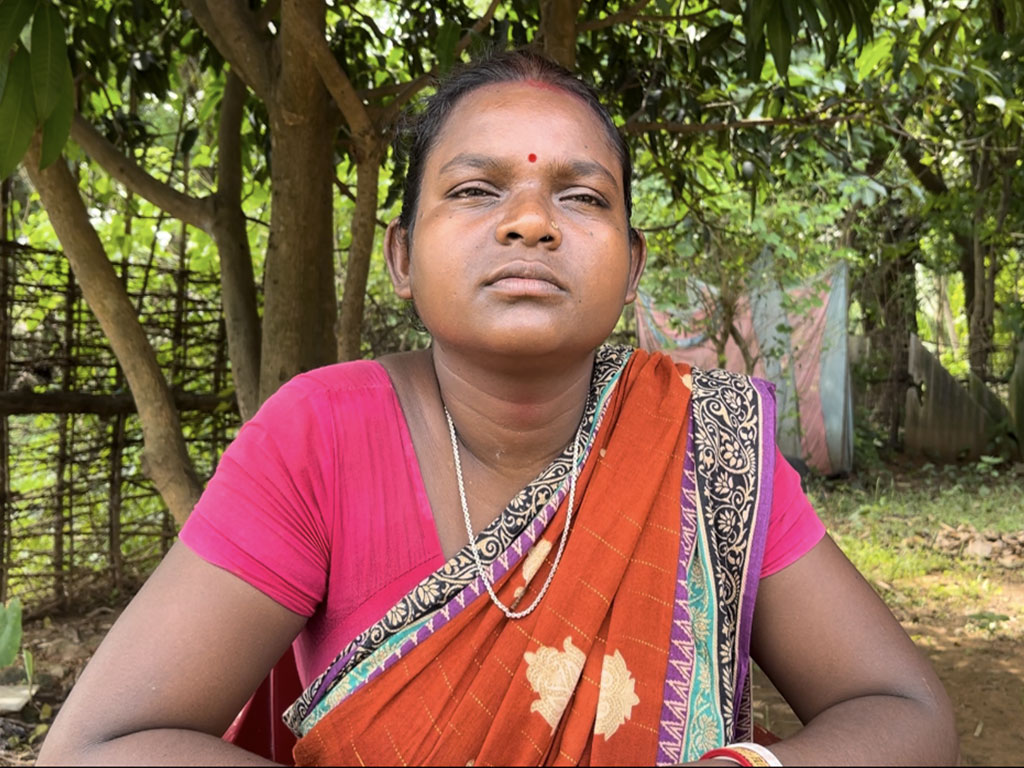
Rani Singh, the Sarpanch of Shyamsundpur GP, has made history as the first tribal woman to hold the position in her Gram Panchayat in 75 years. Her journey, however, began with her association with Nydhee, where she worked as an NGO staff member. The development activities she participated in ignited a passion within her to drive change in her own community. Determined to make a greater impact, Rani contested in the local elections and emerged victorious. Now, as the leader of her GP, she is dedicated to ensuring that government schemes reach all corners of the village and that infrastructure is effectively utilized for the benefit of the people.
A Path of Determination and Growth
Born into a tribal family, Rani’s opportunities were limited from the start. At the age of 14, she was married off, forcing her to abandon her education. Despite this setback, she never lost sight of the value of learning. Years later, while juggling family responsibilities and her role as a Nydhee staff member, she took the bold step to resume her studies, eventually completing her 12th-grade education. To fund her schooling and support her family, she sold local produce in the market, demonstrating her resourcefulness and determination.
Her experience with Nydhee had exposed her to the world of community development, where she learned about various schemes, the importance of grassroots mobilization, and the potential of goat rearing as a source of livelihood. This knowledge would later become instrumental in her journey as a leader.
Winning the Election and Becoming the First Tribal Sarpanch
Encouraged by her passion for development work, Rani decided to run for the position of Sarpanch. Winning the election was not just a personal victory but also a symbolic moment for the entire tribal community, which had never before seen one of their own in such a leadership role.
As the first tribal woman Sarpanch, Rani understood the challenges faced by the marginalized sections of society better than most. She made it her mission to ensure that all government schemes, especially those targeting the needy, reached every village in her GP. Whether it was healthcare, education, or rural infrastructure, Rani made sure that funds were used effectively and that no family was left behind.
Championing Goat Rearing as a Livelihood
One of the key areas where Rani has made a significant impact is in promoting goat rearing. Having personally experienced the benefits of goat rearing, she firmly believes that goats are a valuable resource for rural families. She fondly refers to goats as “living assets,” comparing them to items that can be sold whenever immediate cash is needed.
Rani herself owns 20 goats and encourages others in her community to adopt goat rearing as a sustainable livelihood. She has worked closely with Nydhee to ensure that training and resources are provided to families interested in the practice. Her advocacy for goat rearing has helped many women in her village, providing them with a steady source of income to improve their household finances.
Bridging Education and Development
Rani’s commitment to education extends beyond herself—she has made it her priority to ensure that her children receive a quality education. The income from selling goats has enabled her to send her children to school and provide them with opportunities she never had as a child. In her role as Sarpanch, she is also working on improving access to education for other children in her GP, recognizing that education is the key to breaking the cycle of poverty.
Rani Singh’s journey from an NGO staff member to the Sarpanch of Shyamsundpur GP is a story of resilience, leadership, and vision. As the first tribal woman to hold this position, she has brought a unique perspective to governance, ensuring that government schemes reach the most marginalized sections of her community. Her promotion of goat rearing as a sustainable livelihood has empowered many women, while her personal commitment to education has inspired others to pursue learning despite obstacles.
Rani’s story is one of triumph against the odds—proof that with determination and vision, barriers can be broken, and meaningful change can be achieved.